Lace borders have long been a striking feature of military uniforms, transforming functional garments into symbols of power, distinction, and tradition. While lace may evoke images of delicate evening gowns or bridal attire today, its journey through military regalia tells a very different story. From its early use as decoration in the 17th century to its decline in the 19th century, lace borders have played a vital role in signaling rank, regiment, and even the role of the wearer. In this blog post, we explore the history of lace borders in military uniforms, how they were used, and their lasting influence on both fashion and the world of military antiques.
The Origins of Lace in Military Fashion
Lace itself has a rich history that dates back to the Renaissance, but it was in the 17th century that lace borders first made their way into military fashion. This period marked a time when elaborate garments and ornate embellishments became popular among European nobility and military elites. Lace, originally crafted by hand from delicate threads of silk or linen, was highly prized for its intricate patterns and beauty. It began as a luxury item used predominantly by the wealthy, but as the baroque era unfolded, lace’s ornamental appeal found its way into military uniforms.
By the late 1600s and early 1700s, European armies such as those of France, Britain, and Spain were adopting lace as a standard decorative feature on their uniforms. Lace borders adorned the cuffs, collars, and edges of coats, transforming the standard military attire into something both visually striking and indicative of social and military status. The use of lace was not only an aesthetic choice but also a practical one, as it helped to distinguish different regiments, ranks, and roles within the army.
Types of Lace and Braid Used in Military Uniforms
Lace in military uniforms was not always the fine, delicate material one might imagine today. Instead, the lace used in military regalia came in several forms, each chosen for its durability, visibility, and ability to withstand the demands of military service.
-
Needle Lace: This was the traditional form of lace, created with a needle and thread to form intricate patterns. Needle lace was often used in the 17th and 18th centuries for high-ranking officers' uniforms, where its fine detail made it an excellent marker of status. It was typically sewn along the edges of sleeves, cuffs, and collars, adding a luxurious touch to uniforms.
-
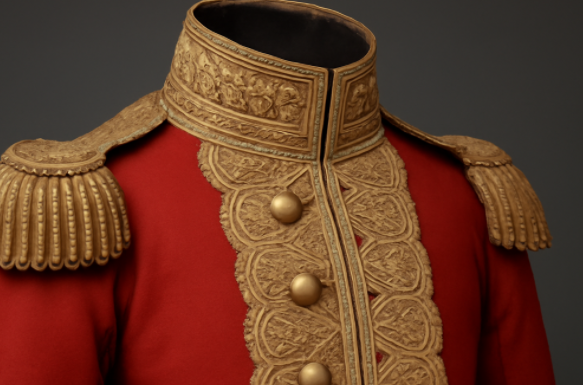
Metallic Lace: In the 18th and 19th centuries, metallic threads were introduced to military lace, adding a more durable and eye-catching alternative to traditional lace. This type of lace was often made of gold or silver threads, making it highly prized and symbolic of wealth and rank. It was commonly used on the coats and caps of officers in various European armies.
-
Braid and Tape: Alongside lace, braided tapes became an important element of military uniform design, especially in the 19th century. While not technically lace, these braids often mimicked the decorative effect of lace and were used in the same way. Made from threads of silk, wool, or metallic fibers, braids were applied to coat edges, cuffs, and collars, sometimes forming intricate patterns that signified a soldier’s position or regiment.
Lace Borders as Military Decoration
The role of lace borders in military uniforms was more than just decorative—it was a powerful symbol. Different armies used lace in specific ways, incorporating it into various parts of the uniform to denote rank, role, or function.
-
British Military: In Britain, lace became synonymous with the “scarlet coat,” which was the iconic uniform of the British Army during the 17th and 18th centuries. Lace was particularly prominent on the cuffs, collars, and the trim of coats worn by officers, soldiers, and even musicians. The lace itself was often accompanied by elaborate gold or silver braiding, indicating the wearer’s higher status. Military musicians, for instance, were often adorned with lace borders as a symbol of their specialized role within the regiment.
-
French Military: The French Army, particularly during the reign of Louis XIV, was known for its opulence in military fashion. Lace was prominently featured on the uniforms of the French cavalry and artillery, often applied to cuffs, collars, and the edges of coats. Officers in the French military were distinguished by their ornate lace borders, which often included metallic threads, while soldiers wore simpler lace, usually in white or off-white.
-
American Military: The use of lace in American military uniforms was less widespread in comparison to European armies, but it still appeared in early uniforms, particularly those of the Continental Army during the American Revolution. Lace borders were used as trim on coats and cuffs, and often, the lace was white or cream, contrasting with the dark blue or red of the uniform.
In all these armies, lace borders were not just ornamental—they served as a clear indicator of hierarchy. Officers, musicians, and other specialized ranks had more elaborate lace and braidwork, while common soldiers had simpler, less ornate designs. The use of lace borders was therefore a reflection of military tradition, a mark of distinction that signified the wearer’s role and social status.
The Decline of Lace Borders in Military Uniforms
By the 19th century, with the rise of mass-produced uniforms and the adoption of more functional, streamlined military attire, the use of lace borders began to decline. The Industrial Revolution made the production of uniforms more efficient, and the elaborate handwork involved in creating lace borders was no longer practical for large-scale manufacturing.
The Napoleonic Wars and the subsequent military reforms of the early 19th century emphasized practicality and uniformity over the ornamental extravagance that had characterized previous military dress. As a result, lace borders, though still retained in some ceremonial or dress uniforms, were gradually phased out of everyday military attire. Instead, military uniforms became more standardized, with simpler cuts, less decoration, and a focus on the uniformity that mass production allowed.
Lace Border Design in Modern Fashion and Military Antiques
Despite its decline in active military uniforms, lace border design continues to inspire both fashion and the world of military antiques. In fashion, lace elements have been integrated into formalwear, particularly in vintage and haute couture designs that draw upon historical styles. Designers often look to the ornate lace used in 17th- and 18th-century military uniforms for inspiration, reviving it in contemporary garments that combine luxury with historical references.
In the world of military antiques, lace borders remain highly collectible. Uniforms from the 17th and 18th centuries, with their delicate lace trims and intricate braids, are prized for their craftsmanship and historical significance. Military collectors and historians study these uniforms not only for their design but also for the insights they offer into military culture and the social hierarchies of the past. The lace itself, in all its forms, tells a story of status, tradition, and the evolution of military regalia.
Conclusion
The history of lace borders in military uniforms is a fascinating journey through fashion, function, and symbolism. From its origins as a luxury decorative element to its role as a marker of rank and distinction, lace has played a crucial part in shaping the visual identity of military attire. Although it has largely disappeared from modern military dress, lace borders continue to influence both fashion and the world of military collecting today.
Explore more about the fascinating history of military regalia and discover how historical lace designs continue to captivate collectors and fashion enthusiasts alike by visiting baariya.com.